
Grid Memory catches
the things your
AI agents forget.
Shared persistent memory for multi-agent teams. Amnesia detection, conflict detection, decision graphs — one line of code.
npm install grid-memorypip install grid-memoryAgents forget.
Teams fail.
The same problem gets discovered and re-solved by different agents on different days. No shared context, no continuity, no institutional memory.
One agent writes a wrong fact. Three agents read it and act on it. Research shows 87% of downstream decisions are corrupted within 4 hours of one bad write.
When production breaks, which agent wrote the triggering fact? When? What did it contradict? Current tooling cannot answer this. Debugging takes days.
This is not a model problem. It is not a prompt problem. It is a memory architecture problem — and it has no production solution today.
Three features. All free forever.
The features that make engineers stop and stare. Community tier, always.
One line of code. Everything changes.
Point at Grid Memory
Replace your OpenAI base_url. Full streaming, full compatibility. Zero agent code changes required.
Decisions get logged
Every agent writes what it decides, discovers, or observes. 9 typed entry types with TTL.
Problems get caught
Conflict detection, amnesia detection, staleness scoring — running on every single write.
Answers appear
What was forgotten? What caused the incident? What did we accomplish this quarter?
Start free. Scale when it matters.
Amnesia detection, conflict detection, and decision graphs are free forever under BUSL-1.1.
Everything you need to evaluate Grid Memory in production.
Production governance and compliance for engineering teams at regulated companies.
Executive-grade intelligence for consulting firms and PE-backed companies.
The QBR that used to
take 20 hours.
Turn every agent decision into executive-grade intelligence. Generated in seconds.
QBR Generation
Full quarterly business review from agent memory in seconds
Opportunity Pipeline
Stage-weighted forecasting and revenue expansion scoring
Portfolio Analytics
Cross-client rollups and PE operating dashboards
Board Reporting
Executive dashboards your board can actually read
See what your agents actually know.
Not just raw logs. A live intelligence dashboard that translates agent memory into business impact — contradictions, amnesia risk, decision quality, and the chain of "if that is true, what else is true too?"
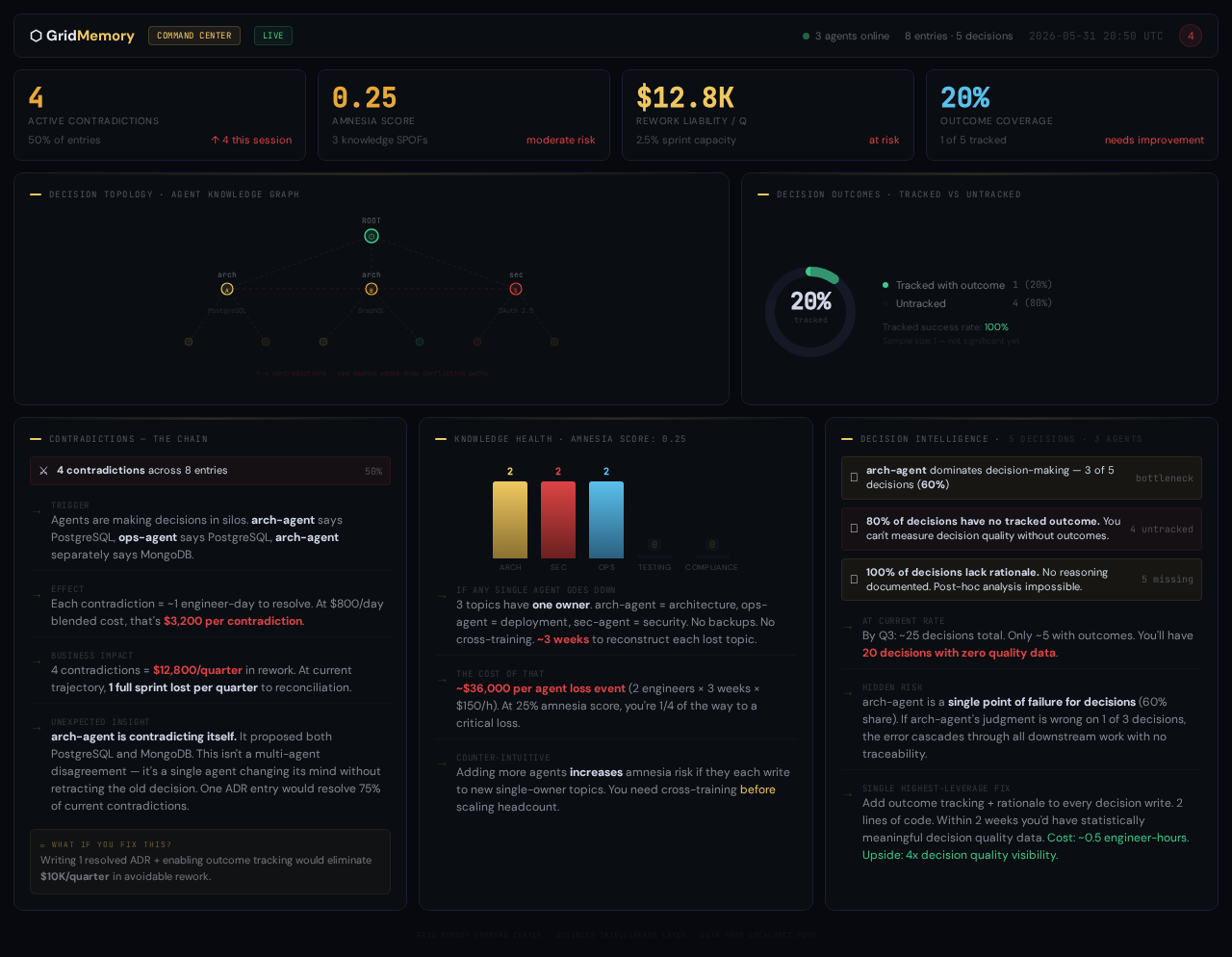
Every metric chained through "if that is true, what else is true?" — with dollar values, risk exposure, and prioritized recommendations